
Nutrition Desk: 5 Reasons Chocolate Won't Deliver Morning Sharpness
Looking for a practical way to support an active mind? Start with the difference between chocolate flavor and a measured cocoa flavanol serving... then meet the once-a-day stick pack designed to make that distinction simple.* Individual results vary.

I stood at the kitchen table holding my handwritten list of questions for Tuesday’s doctor appointment. Beside my morning cup sat a brown CocoaVia stick pack. My sister glanced from the packet to the paper. "Taking that along, Eleanor?"
"The label, yes," I told her. "And my questions." I wanted to understand what I was considering before making it part of breakfast.
*Ask about the actual product,* I reminded myself. A familiar cocoa flavor was one thing; a measured flavanol serving was another.
Perhaps you recognize that small kitchen-table pause. You are interested in supporting an active life, but you want more to go on than a reassuring word on a wrapper.
You want to keep enjoying conversations. Follow the story. Finish the book. Stay curious about the people and plans that fill your life.
That is a very human ambition.
My sister pulled up a chair. "Then let’s read what it actually says."
The United States had 61.2 MILLION adults age 65 and older in 2024, according to the Census Bureau. That is a population count, not a count of people with memory concerns... but it shows how many Americans are navigating this stage of life. Source: U.S. Census Bureau — https://cdn.www.census.gov/newsroom/press-releases/2025/older-adults-outnumber-children.html.
For many readers, the next question is practical. How do you build a nutrition routine you can actually keep, without turning breakfast into a project?
My sister had heard the familiar advice too: have some dark chocolate. It was the sort of suggestion you could pass along without ever looking at a label.
“Just have some dark chocolate.”
"Sounds like my kind of research," she said, smiling. I understood the appeal. Cocoa really does contain compounds that researchers study; the question was which ones, and how much.
But here is the catch...
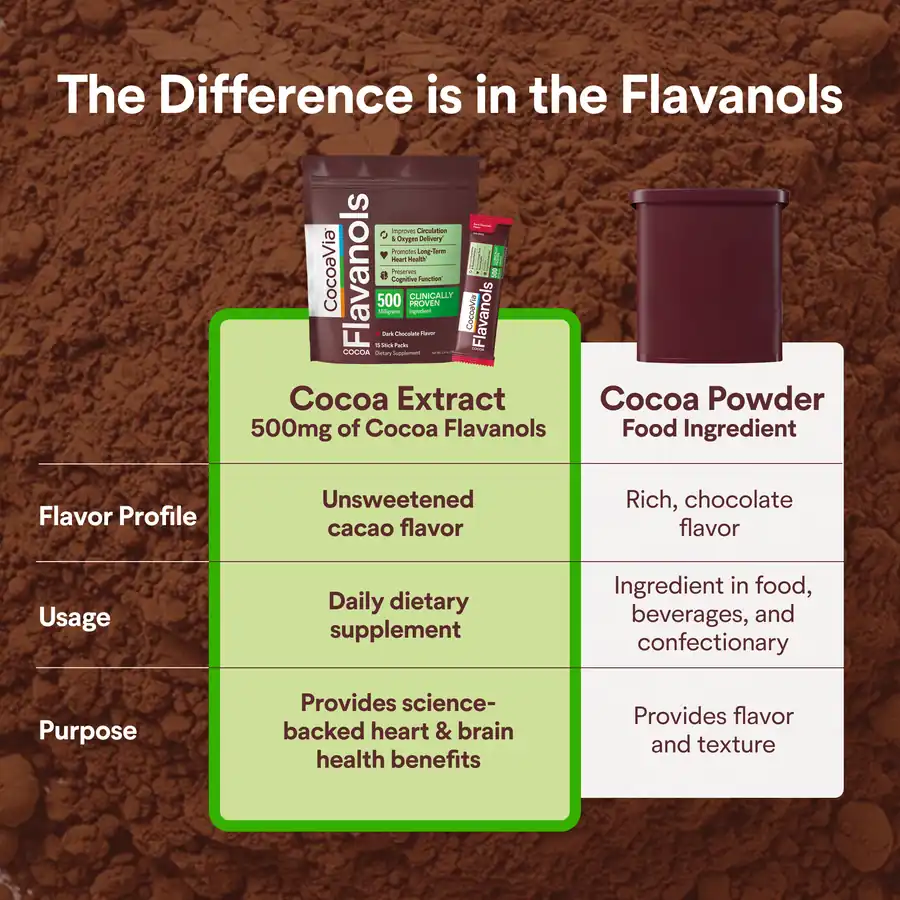
Chocolate on the front of a package does not tell you how many cocoa flavanols are inside. Neither does a rich color, a bitter taste, or an impressive cacao percentage.
If your goal is a MEASURED flavanol routine, ordinary chocolate leaves several important questions unanswered.
That was the question I wrote down.

What If the Useful Part of Cocoa Isn’t What You’re Shopping For?
My sister and I pictured the chocolate aisle, a different wrapper in each hand. You can almost make the choice by color alone.
One says dark. One says extra dark. Another promises an intense cocoa experience. Each looks as though it should be the sensible choice.
But you are trying to answer a different question: how much of the particular plant compounds used in flavanol research would a serving provide?
The package may never tell you.
That does not make chocolate a bad food. It makes it a very imprecise shortcut for a precise nutrition goal.
Those are different shopping decisions.
You can enjoy chocolate for flavor while choosing a measured cocoa extract for a separate purpose. There is no need to force one purchase to do every job.
The more useful comparison starts with what you can read on a label. Look for the amount of cocoa flavanols per serving, the serving directions, and the format you would use.
Then ask whether that format belongs in your actual morning.
Not the morning you imagine having on a quiet vacation. The real one... with the ringing phone, the half-finished grocery list, and somebody asking where the car keys went.
A simple routine has to survive THAT morning.
This is why single-serving powder sticks deserve a closer look. They put a stated amount into a format that can join something you already prepare.
No elaborate recipe needed. No new appliance required. Just a label you can read and a breakfast habit you already understand.
Before we introduce the product, though, let’s make the comparison clear.
There Are 5 Reasons Ordinary Chocolate Won’t Do the Job of a Measured Flavanol Supplement

These five problems concern DOSE, labeling, processing, serving choices, and research comparisons. If you want a measured daily routine, those details make ALL the difference. They do not mean chocolate has no nutritional value.
And they do not mean every reader needs a supplement.
They explain why buying chocolate by appearance is a poor way to select a specific amount of cocoa flavanols.
1. A Cacao Percentage Is NOT a Flavanol Amount
A large number on a chocolate wrapper can feel reassuring. You see a higher cacao percentage and assume you have found the more useful choice.
But that percentage describes the proportion of cacao-derived ingredients. It does not report a standardized flavanol serving in milligrams.
Here is the practical difference: “70% cacao” and “500 mg cocoa flavanols” answer different questions. The first describes a recipe proportion. The second describes a stated quantity of particular compounds.
"So darker doesn’t give me the number?" my sister asked. You cannot turn one into the other simply by moving a decimal point.
Think of choosing a food because it contains a familiar ingredient. Knowing that the ingredient is present does not tell you the exact amount of every compound associated with it.
That is why a specific flavanol number matters when you are comparing a product with a research serving.
You need a quantity that refers to the SAME thing.
A high cacao percentage may influence flavor and preference. It still leaves the flavanol question open unless the manufacturer supplies that information separately.
For a shopper, that creates an unnecessary guessing game. You can spend more on a darker wrapper and still finish without the one number you wanted.
The solution is to ask a better label question before comparing prices: does this product state cocoa flavanols per serving?
If the answer is no, you have learned something useful. You are considering a chocolate purchase, rather than a measured-flavanol purchase.
Keep that distinction in mind as we move to the next problem... because even powders that look similar can differ substantially.

2. Processing Can Change What Remains in the Cocoa
Dark color can create a powerful impression. So can a deep chocolate smell.
Neither is a laboratory measurement.
A 2008 analysis in the Journal of Agricultural and Food Chemistry reported average total flavanol levels of 34.6 mg/g in natural cocoa powders, compared with 13.8 mg/g, 7.8 mg/g, and 3.9 mg/g across increasingly alkalized categories. These were sampled powder averages, not values for every product sold today. Read the study — https://pubmed.ncbi.nlm.nih.gov/18710243/.
That is a substantial range hiding behind a familiar ingredient name.
The buying lesson is straightforward: appearance cannot substitute for a stated amount. A darker-looking powder does not automatically answer your nutrition question better.
If a product was made for a particular flavor or baking result, that may be exactly what you want in a recipe.
But your breakfast routine asks another question. Can you identify a consistent serving of the compounds you came to investigate?
With an unlabeled flavanol amount, you are still estimating.
And estimates become even less useful when you start comparing a spoonful from one container with a spoonful from another.
"But it looks like the same cocoa," my sister said. The scoop looked similar; the ingredient name sounded right. Neither observation supplied the missing measurement.
Yet none of those observations gives you a measured flavanol serving.
No chemistry degree required... just the right number on the right line of the label.
3. A Bigger Chocolate Serving Also Changes Everything Else You Eat
Suppose a small chocolate serving does not tell you the flavanol amount. It is tempting to think a bigger serving must solve the problem.
But bigger does not mean better measured.
You may increase the amount of food without ever learning the amount of the compound you wanted. You have changed your snack, while the original question stays unanswered.
Depending on the product, you also change the calories, sugar, and fat in that snack. Those details belong in the decision too.
This is a reason to separate enjoyment from dosing. Eat a favorite food because it fits your meals and preferences. Choose a measured supplement by its actual serving information.
For comparison, the documented CocoaVia listing describes 500 mg of cocoa flavanols in one stick pack, with 10 calories and no added sugar per serving. That is a defined package proposition... not an invitation to eat more chocolate.
The current label remains the place to confirm all ingredients and nutrition details before ordering.
What matters here is the structure of the choice. One serving gives you a stated flavanol amount. You do not have to increase a dessert portion and hope it gets you closer.
That can make a supplement format easier to consider alongside an ordinary breakfast.
Especially if you already have a drink or bowl you enjoy.
You can make a deliberate decision about the addition instead of using a larger snack as an improvised measuring tool.
And you can keep enjoying chocolate when you want chocolate.
The two choices do not need to compete for the same explanation.
4. An Unmeasured Spoonful Gives You No Reliable Daily Target
Some mornings your spoon is level. Some mornings it is generous. Some mornings you pour directly from the container because the spoon is somewhere in the dishwasher.
I call that *the dishwasher scoop*. Perfectly normal kitchen behavior; a poor way to describe an exact serving.
It also makes an improvised serving a poor stand-in for a specified research intake.
Research reports amounts and schedules for a reason. If an intervention uses a stated daily quantity, an unspecified spoonful is not the same description.
You do not need to turn breakfast into a laboratory to appreciate that difference.
You just need a format that removes an avoidable question.
The stick-pack format puts the serving into an individual packet. The seller’s directions are to mix one stick daily into a suitable food or beverage; confirm the current directions on your package.
One packet. One stated serving. A familiar place in the morning.
That is the convenience argument.
It does not establish a personal result. It does make the product easier to understand and use as labeled.
Consider the difference when you travel. A loose container asks you to pack, measure, and keep track of a scoop. An individual packet is a different format for the same kind of daily decision.
Or consider a busy household. You can see whether the packet is still beside your cup without remembering which spoon you used.
The practical appeal is small, specific, and easy to picture.
Sometimes that is exactly what a routine needs... fewer steps between the intention and the action.

5. “Cocoa Was Studied” Does NOT Mean Every Chocolate Product Was Studied
This is the most important comparison of all.
A paper can investigate cocoa extract without investigating your favorite candy bar. It can investigate one serving amount without establishing what a smaller, unspecified amount would do.
And it can report a finding in one group without establishing the same result for every reader.
COSMOS-Web enrolled 3,562 older adults and assigned cocoa extract containing 500 mg flavanols daily or placebo over three years. Its prespecified overall memory result at one year was not statistically significant. Findings among participants with lower baseline diet quality or flavanol intake were more encouraging. Published research — https://pubmed.ncbi.nlm.nih.gov/37252983/.
That is a reason to examine the details... rather than turning the word cocoa into a universal promise.
When you read a study headline, ask what was actually used. Ask who participated. Ask whether the result applies to the whole group or to a subgroup.
Those questions protect the value of the research. They also help you make a cleaner product comparison.
A measured extract gives you a clearly stated quantity to inspect. It does not make every finding transferable to your own life.
This is why the alternative we are discussing is specific: a once-a-day measured cocoa flavanol format for adults interested in daily nutritional support.* Individual results vary.
A serving you can identify. A format you can picture using. A practical next step for your daily nutrition routine.
Just a practical way to consider a defined ingredient amount alongside the rest of your routine.
Now let’s look at why researchers became interested in that ingredient in the first place.
Studies Point Beyond the Chocolate Aisle... Toward the Compounds Inside Cocoa
The obvious option is to buy something chocolate flavored and assume the useful part comes along for the ride.
The research question is more specific.
Can particular cocoa compounds be studied in measured amounts, under controlled conditions, using outcomes that researchers can compare?
That question moves the conversation from a wrapper to an ingredient.
And it helps explain why an ordinary food aisle can be an awkward place to shop for a defined daily flavanol amount.
You may see words that describe intensity, origin, texture, or taste. Those are useful descriptions when they match what you want to buy.
But none automatically gives you the quantity needed for a study comparison.
For that, you need a clearly stated serving and enough information to understand what the serving represents.
The practical alternative is not a more elaborate chocolate ritual. It is a simpler way to identify the amount you are choosing.
A powder stick is one way to do that.
It keeps the daily action familiar while making the label question more precise.
You can still ask about flavor, mixing, cost, and ingredients. In fact, you should.
A product deserves a place in your kitchen only if it fits the life already happening there.
But first, follow the ingredient back a few steps... before the mug, before the packet, and before the chocolate wrapper.

Start With a Cocoa Bean... Then Follow the Question Researchers Asked

Picture a cocoa bean before it becomes anything recognizable on a grocery shelf.
It is the beginning of a range of products that can look, taste, and behave very differently by the time they reach your kitchen.
A baking powder. A dessert ingredient. A chocolate bar. A cocoa extract used in research.
The origin is connected. The finished products are not interchangeable descriptions.
That distinction is the heart of the ingredient story.
My journey here began with the published record, spread across the same kitchen table. If you have ever read a study abstract beside a cooling cup, you know how quickly a simple shopping question can grow.
The useful discovery is the change in the question: instead of asking whether chocolate sounds healthy, ask which compounds were measured and how they were studied.
Cocoa flavanols are plant compounds associated with cocoa. Researchers can characterize them, select an intake, and investigate particular outcomes.
That makes a very different kind of conversation possible.
One that involves a protocol instead of a recipe. A comparison group instead of a favorite flavor. A reported result instead of a pleasing morning impression.
For someone interested in nutrition, that can be a compelling path to follow.
You do not need to read every technical paragraph to appreciate why specificity matters. You need to understand what each step adds to the story.
An ingredient name tells you where to look. A measured serving tells you how much was used. A study tells you what the researchers investigated under those conditions.
The product label then tells you what is offered for sale.
Keep those steps connected... and you can make a practical comparison without asking the story to carry more than the evidence does.
A Small Study Made the Question More Interesting
A small trial can make an ingredient worth investigating further.
It cannot tell you how you will perform at next month’s family dinner.
That distinction matters because laboratory tasks and everyday life ask different things of people. A controlled measurement is useful precisely because it narrows the question.
I thought of the conversations I enjoy with my sister. Your life is broader than the measurement.
A conversation involves attention, interest, timing, and the pleasure of being with another person. A study result should not be turned into a scripted scene in which all of that changes after a purchase.
Instead, take the study for what it offers: one step in a larger investigation of an ingredient.
Then look for the next step.
Were more people studied? Was there a comparison group? Did the later work examine the same question or a different one?
Those are useful questions even if you never buy a supplement.
They are especially useful if you are comparing two products that both mention science.
A long list of scientific words is easy to print. A clear account of what was actually done is more useful to the person holding the shopping decision.
That person is you.

21,442 Adults... and a Reason to Look at the Details
A large participant count gets attention for a good reason. It represents a substantial research undertaking.
But size is the beginning of the explanation, rather than the whole explanation.
A research program can contain different investigations, with different groups completing different assessments. The name printed above them does not make every result identical.
That is why you should pause when an advertisement places a very large number beside a very personal promise.
I added a line to my notes: *What does that number count?*
Participants in the parent trial? People in a particular analysis? Those who completed a specific assessment? The answer changes what the sentence means.
For our product discussion, the useful connection is the maker’s stated ingredient and serving-level relationship to the research program.
It is a reason to inspect the product more closely.
It is not a reason to skip the rest of the page, assume a personal result, or overlook the actual format used in a study.
The good news for a shopper is that you can keep the decision manageable. You do not have to solve every research question before reading a label.
You need a clear product identity, an understandable serving amount, and realistic expectations about what nutritional support means.
Then you can decide whether the format and price make sense for your routine.
What the Bigger Memory Investigation Actually Added
This is where the story becomes more useful than a blanket claim.
Nutrition research can raise questions about a person’s starting point. People do not all arrive with the same eating patterns, habits, or circumstances.
That does not give a reader a way to identify their own status from an advertisement.
It does give you a reason to be cautious about sentences that promise the same effect to everybody.
You may be interested in a measured flavanol routine because you like the ingredient, the format, or the idea of adding a clearly labeled serving to your day.
Those are practical reasons to consider a product.
You do not need to call yourself part of a research subgroup to make that decision.
And you should not use misplaced keys, an unfinished crossword, or a busy afternoon as a substitute for the assessments used in a study.
The article can help you shop with clearer questions. It cannot classify your nutrition status or explain personal changes in daily functioning.
Keep the purpose simple: learn about the ingredient, inspect the product, and consider whether the daily format fits.

Another Major Study Found No Overall Cognitive Benefit From Cocoa Extract
You deserve to see this alongside the more encouraging findings.
It keeps the product decision in proportion. A measured ingredient serving is a factual product feature; an assured change in your mental performance is a different claim.
The first can be read on a label. The second requires evidence that this advertisement does not have.
That leaves a practical reason to keep reading: convenience, ingredient transparency, taste preferences, and the ability to choose a defined amount.
Those features can matter in a real household.
A supplement does not need to become the explanation for your entire future to be worth examining. It needs to make sense as the optional nutrition purchase it is.
So keep the research in view... and bring the decision back to breakfast.
Would you prefer a powder over another format? Do you already enjoy cocoa in a drink or bowl? Would an individual packet make the routine easier to organize?
"Now those I can answer," my sister said. So can you.
And they lead naturally to the product itself.
A Measured Cocoa Flavanol Serving... in One Everyday Stick Pack

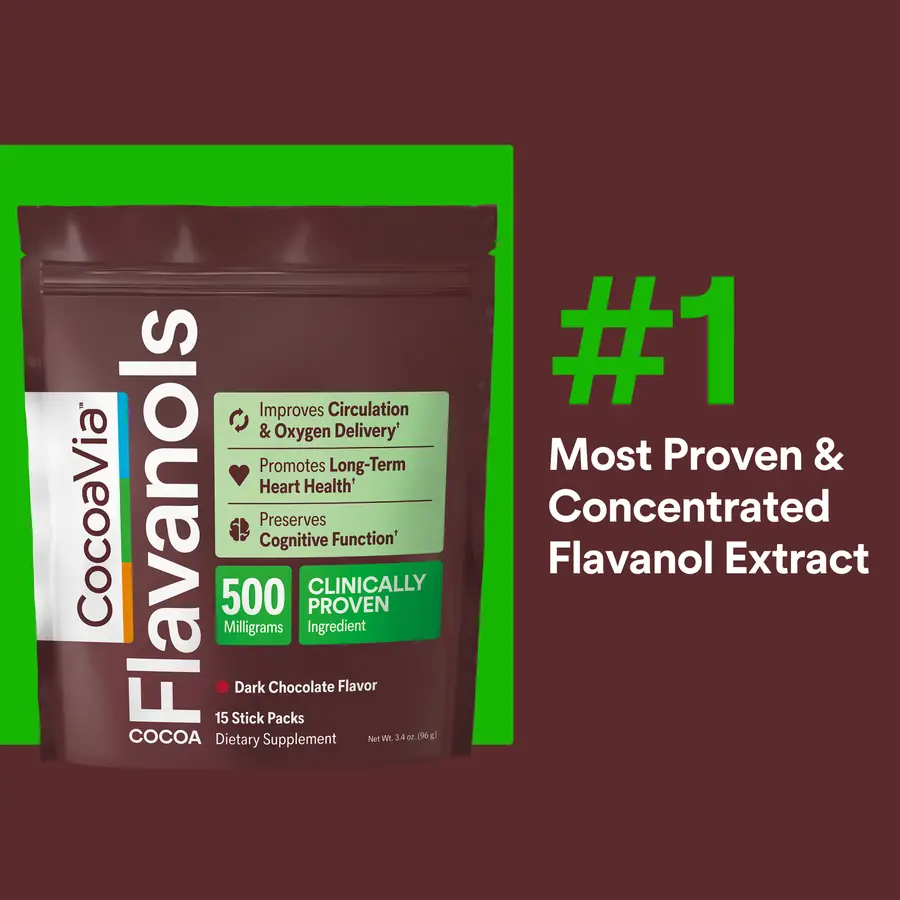
Introducing CocoaVia™ 500mg Cocoa Flavanols Powder Stick Packs from Mars Edge, a segment of Mars, Incorporated.
The idea is straightforward: a measured cocoa flavanol serving in a single-use powder packet you can add to an existing breakfast.
The documented box contains 15 stick packs.
Each stated serving provides 500 mg cocoa flavanols from Cocoapro™ cocoa extract.
The seller lists no added sugar and 10 calories per serving. Read the current label for the complete ingredient and nutrition information.
And the format is designed to work with foods and drinks people already know: coffee, a protein shake, yogurt, or oatmeal, following the package directions.
That is the appeal.
You do not have to make room for a complicated ritual. You can examine one addition to something you already prepare.
- 500 mg cocoa flavanols per stated serving
- 15 individual powder stick packs per documented box
- Cocoapro™ cocoa extract identified by the maker
- No added sugar and 10 calories per serving, per the seller
- A format designed to fit an existing breakfast routine
- Seller-listed 100-day risk free guarantee and free U.S. shipping; current terms apply
CocoaVia’s cocoa flavanols are intended to support healthy circulation as part of a daily wellness routine.* Individual results vary.
For readers interested in mental sharpness, the research context is worth exploring... while remembering that the studies do not establish a guaranteed cognitive benefit from this product.
The purchase starts with the product you can verify: a specific format, a stated serving, and a real seller you can contact.
15 stick packs · documented price $29.99 · current seller terms apply

What Scientists Mean by Healthy Blood Flow Support

Without getting lost in technical language, start with a familiar idea: your body has systems that move blood where it is needed.
Research can examine how those systems respond under controlled conditions.
For cocoa flavanols, one area of interest involves the lining of blood vessels and signaling associated with nitric oxide. That is a research mechanism... a description of a biological research question.
A useful explanation should help you understand the question, rather than persuade you that a complicated phrase guarantees a result.
The takeaway is an area of scientific interest, with specific limits.
A measured response in an experiment is not the same as a feeling you can reliably recognize while making breakfast.
And a mechanism does not replace an outcome study.
Still, understanding the research question can help you see why a measured ingredient amount attracts more attention than the word chocolate alone.
The amount is something investigators can specify. The conditions are something they can describe. The findings are something other researchers can examine.
That is a useful chain of questions to keep in mind as a shopper.
What was used? How much? Under what conditions? What actually changed?
Then return to the package and ask a separate question: what am I buying here?
With CocoaVia stick packs, the answer is a powder supplement with a stated cocoa flavanol serving... designed to make daily use straightforward.
That clarity is a benefit of the format even before you consider whether you want to place an order.
A Brain-Flow Measurement Is Interesting... and Still Has a Specific Meaning
This is a helpful point to understand before buying any supplement advertised around an active mind.
The body can be studied in more than one way. A scan, a task, and a personal impression are different forms of information.
Putting them side by side can help explain a research direction. Reading them as interchangeable can create an expectation the evidence does not support.
You do not need an instant sensation to understand the product format.
The packet does not come with a valid home test for whether a particular biological response occurred. The taste of the drink cannot tell you that either.
What you can observe is practical: whether the powder suits your breakfast, whether the directions are easy to follow, and whether the recurring purchase fits your budget.
Those observations have a useful job.
They help you decide whether the product belongs in your routine as an optional supplement.
And they keep ordinary daily variation from turning into a sales demonstration.
Enjoy a pleasant morning for what it is. Read a study result for what it measures. Choose a supplement for a purpose the label and evidence can support.

An Ingredient You Can Measure Is Easier to Compare
You have probably seen a product page with an impressive ingredient list and very little usable serving information.
The names are there. The story is there. The amount you wanted is hard to find.
That makes comparison unnecessarily difficult.
A stated cocoa flavanol serving gives you a defined starting point. You can read the quantity and compare it with the product description, rather than relying on the mood of the page.
The same principle applies when you compare formats.
A tub may suit someone who prefers measuring at home. A packet may suit someone who values an individual serving. The better choice depends on the person using it.
For this page, the product is specifically the powder STICK PACKS.
That means the practical discussion stays focused on opening a packet and mixing it as directed. It does not turn into advice about a different product with a different serving.
There is no need to describe a small box as a much longer supply or to imply that the research result depends on buying a larger bundle.
The decision can stay concrete.
Would you use this format? Do you enjoy the foods it is intended to join? Is the stated amount the one you meant to compare?
Answer those questions first... and the rest of the product page becomes easier to read.
Coffee, a Shake, or Oatmeal... Choose the Routine You Already Have

A product can sound wonderfully simple until you imagine the first ordinary weekday.
I know how this goes: the blender is in a cupboard, and the recipe needs ingredients I forgot to buy. My sister calls it *the imaginary breakfast*. You may have planned one yourself.
This is where an existing breakfast earns its value.
If coffee is already part of your morning, you have a familiar place to consider the powder. If you prefer a shake or oatmeal, you have another route to read about on the label.
Choose the format you already enjoy.
There is no need to become a different kind of breakfast person to consider one addition.
Before your first use, read the mixing and serving directions. Use the stated serving rather than improvising a larger amount because the ingredient sounds appealing.
Then give the practical experience a fair look.
Do you like the flavor in that particular food? Is mixing convenient? Is the packet easy to keep with the breakfast items?
Those are useful first impressions because they concern what you can actually experience.
A sustainable routine starts with an action you are willing to repeat.
And the easiest action to repeat is often one that belongs beside something you already do.
That is the everyday attraction of this format... familiar breakfast, clearly stated serving, one less thing to measure.

A Packet Can Simplify a Routine... Even When the Day Is Busy
Back at my table, Tuesday’s appointment was still ahead. My handwritten questions mattered more than adding another kitchen task.
You know that morning: checking the time, finding a jacket, hunting for the parking instructions. I wanted breakfast to stay familiar while I gathered what I needed.
Nobody needs a complicated kitchen task at that moment.
An individual serving can make a product easier to organize because the portion is already packaged. You still follow the directions, but you have fewer measuring decisions.
That is a convenience benefit you can understand without imagining an extraordinary result.
The same applies when you are away from home.
You can plan around individual packets, provided you store and use them according to the package instructions. The question becomes whether the format suits your day.
A visit with family. A weekend away. A morning when breakfast happens in a different kitchen.
Those are ordinary situations that can make packaging matter.
They do not make a supplement essential. They help explain why some shoppers prefer packets over a larger container.
You may value that convenience enough to choose it. You may decide another format fits better.
Either way, the useful comparison stays practical.
What would you carry? What would you mix it into? Where would you keep the directions? Would the recurring cost remain comfortable?
Answer with your actual habits in mind.
A routine that fits your real day has a much better chance of remaining a routine than one built around an imaginary schedule.
Chocolate in Coffee... Cocoa in a Smoothie... Real Comments, in Their Own Words

Research explains why an ingredient is interesting. Reviews can tell you something different: what a buyer chose to say about an actual purchase.
The seller-review record captured a 4.6-star aggregate from 901 Yotpo reviews on October 31, 2026.
That snapshot describes the review widget at the time of collection. It is not a clinical result or a prediction about your experience.
Here are three complete quotations available in that record.
Cocoa goodness — This product was delightful. It added chocolate goodness to my coffee
Source captured October 31, 2026. The supplied record does not include this review’s publication date.
Love the chocolate taste when I add this powder to my smoothie
Source captured October 31, 2026. The supplied record does not include this review’s publication date.
Ordering was easy. I am not sure I am noticing any difference in my energy, perhaps I will pay closer attention.
Source captured October 31, 2026. The supplied record does not include this review’s publication date.
*Individual results vary. These quotations describe individual buyer experiences. They do not establish a cognitive benefit or a typical outcome.
The flavor comments may help you picture the format. The more uncertain comment matters too... because real buyers do not all describe the same experience.
Use those comments for what they offer, then make your own decision from the label, the research limits, and the current seller terms.
Can You Picture Yourself This Time Next Month... With a Simpler Morning Routine?

Picture the part you can plan.
The mug is out. Breakfast is something familiar. The product directions are clear, and you know where the packet belongs.
You have stopped trying to translate a chocolate wrapper into a flavanol measurement.
You have made a decision about a stated serving instead.
Then the morning continues.
You call someone you enjoy talking to. You step outside. You return to the chapter waiting on the table or make a plan for the afternoon.
Those are the parts of an active life that make a wellness routine meaningful.
A supplement can be an optional addition to that routine. It does not need to take credit for every enjoyable moment that follows.
The future worth picturing is a routine that feels manageable... with more attention left for living your day.
Not a calendar marked with a promised transformation. Not a test you have to pass after breakfast.
My sister put it simply: "I want to know what I’m choosing." That is a useful place to land.
If CocoaVia fits that picture, the next step is simple: read the current product page and decide whether the stick-pack format is right for you.
If it does not, you still leave with a better understanding of how to compare cocoa products.
Either way, you have replaced a vague shopping shortcut with a specific question.
And specific questions are useful companions to any wellness purchase.
Review the current label, price, availability, and return terms

The Documented Offer Is $29.99 for 15 Stick Packs
The supplied product record lists one box at $29.99.
That box contains 15 powder stick packs. At that recorded price, the cost is approximately $2.00 per packet.
The seller lists free U.S. shipping and a 100-day risk free guarantee. Check the current page for availability, price changes, and all applicable conditions.
There is no invented bundle discount here.
At the recorded price, two boxes cost $59.98. Read the exact item and quantity at checkout before placing an order.
If you are thinking beyond the first box, do the simple multiplication before ordering.
Two boxes at the same recorded price total $59.98 and contain 30 packets. That is arithmetic, rather than a claim that the seller offers a separate two-box deal.
This makes the recurring cost easier to picture.
Compare it with your actual budget. You do not have to invent an expensive coffee-shop habit to make the number feel smaller.
The question is whether you want to add this purchase to what you already spend.
That is a personal decision, and a useful advertisement should make the amount easy to understand.
The serving count and price belong together. Seeing both keeps a small first purchase from becoming an unclear recurring commitment.
CocoaVia 500mg Powder Stick Packs · documented offer
A 100-Day Seller Guarantee Gives the Purchase a Clear Next Question
What happens if you decide the product is not the right fit?
The documented seller language is a 100-day risk free guarantee.
That is worth reading before you order.
A guarantee concerns the purchase and the seller’s return policy. It does not promise that the product will produce a particular personal result.
To make the promise useful, check the current conditions: eligibility, when the period starts, how to contact the seller, and what steps apply to your order.
Keep your order confirmation and follow the seller’s instructions if you later need help.
Do not guess where a return should be mailed. Ask for the correct process and address before sending anything.
The corporate contact address in the product record is not automatically a return destination.
These are straightforward purchase details, and knowing them in advance can make the decision more comfortable.
You can consider the product without pretending the guarantee answers a scientific question.
It answers a different question: what policy does the seller provide if the purchase does not suit you?
Read that answer in the seller’s current terms, and keep a copy with your order information.
Seller-listed 100-day risk free guarantee
CocoaVia lists a 100-day risk free guarantee and free U.S. shipping. Review the seller’s current eligibility rules and return instructions before ordering.
For product and order questions: 1-833-262-6284 · [email protected]. Individual results vary; the guarantee is a purchase policy, not a promised health outcome.

What Happens When You Decide to Look at the Offer?
The next step is straightforward... see whether the current CocoaVia offer fits your morning.
Use the product button to continue toward the current seller offer. Read the item name, current stock status, label information, and checkout conditions there.
This page does not reserve stock or create a special supply for you.
There is no clock to race.
You can take the time you need to decide whether the product and terms fit.
If the item is unavailable when you arrive, rely on the seller’s current availability information. An advertisement should not overrule what the shop actually shows.
If the price has changed, use the price shown for the actual order. The figure discussed here is the documented snapshot used to prepare this page.
If you have a question about ingredients or use, get that answered before placing the order.
And if a professional is helping you make personal supplement decisions, bring the actual label to that conversation.
The goal is a clear decision about a specific product.
A button does not need to do more than connect your interest with the information needed to make that decision.
You are still in charge of the purchase.
The convenience is in having the product details, seller contact, and next step close together.
That is enough to move from curiosity to a practical comparison... without turning the comparison into a commitment before you are ready.
Read current availability and the seller’s 100-day guarantee terms
Who Might Prefer the Stick-Pack Format?
Start with your habits rather than a promised outcome.
You may prefer this format if you already enjoy cocoa in coffee, a smoothie, or a breakfast bowl.
You may prefer it if you want a stated flavanol serving without keeping a scoop with a larger container.
You may prefer it if individual portions make shopping and packing easier to organize.
Or you may simply want to examine the product because the ingredient research interests you.
Those are ordinary product preferences. They are a sensible place to begin.
None identifies you as someone who will experience a particular benefit.
The more useful question is whether the format gives you something practical you value.
If you dislike powder in drinks, that matters. If you prefer a different breakfast, that matters too.
A supplement should fit the household choosing it.
You do not need to prove commitment to wellness by selecting a product that does not suit your preferences.
Likewise, if the format looks convenient and the current terms work for you, you can consider it without attaching an extraordinary story to the choice.
Sometimes a well-understood product is appealing because the practical details are easy to picture.
That is the case to examine here.

How to Make the Practical Experience Easier to Evaluate

If you choose to order, begin with the directions on the package that arrives.
Check that the item matches the format you intended to buy. Read the current serving information before making it part of breakfast.
Then choose a familiar food or drink that fits the directions.
Keep the first attempt simple. You do not need a complicated recipe to decide whether you enjoy the format.
Pay attention to the practical details you can observe.
Do you like the flavor? Does the mixing fit the time you have? Is the packaging convenient for the way you prepare breakfast?
Those questions can tell you whether the product is a comfortable addition.
They cannot establish what is happening to your circulation or predict your future mental performance.
That distinction is useful because it keeps you from turning every pleasant or frustrating afternoon into a judgment about one packet.
The practical experience has its own value.
You can decide whether you want to keep using a format without pretending to conduct a home clinical trial.
Keep the seller’s return information available while you make that decision. If the product does not suit you, ask about the applicable policy within the stated period.
And keep your original reason for considering it in view.
You were looking for a measured flavanol product that could fit an existing routine. That is the question the first box can help you consider in practical terms.

A Few Clear Answers Before the Final Button
CocoaVia stick packs: practical questions
This page concerns CocoaVia 500mg Cocoa Flavanols Powder Stick Packs, a dietary supplement in individual powder packets. It is intended to be mixed according to the current package directions.
The documented box contains 15 packets. Read the current listing carefully if you are considering multiple boxes or a different format.
The seller describes use with coffee, a protein shake, yogurt, oatmeal, or another suitable food or beverage. Follow the current label and choose a format you enjoy.
The maker identifies Cocoapro cocoa extract and a stated cocoa flavanol amount. A generic baking-cocoa description does not by itself establish an equivalent measured serving.
No. The studies differ in design and findings, and major cognitive analyses did not show an overall cocoa-extract benefit. A research finding is not a forecast for an individual buyer.
The supplied record gives a capture date of October 31, 2026, but does not include each review’s publication date. This page identifies the capture date without presenting it as the buyer’s posting date.
The documented snapshot is $29.99 for 15 stick packs. Current seller pricing, availability, and checkout conditions govern your actual purchase.
The seller lists a 100-day risk free guarantee. Read the current conditions and ask CocoaVia about eligibility, timing, and return instructions before relying on the policy.
No. Discuss personal questions with a qualified professional and use the current complete label for that conversation.
CocoaVia customer care: 1-833-262-6284 or [email protected]. Ask the seller for the correct return process before mailing anything.
A Familiar Ingredient... a More Precise Way to Choose It
You do not have to stop enjoying chocolate to recognize the difference.
A chocolate purchase can be about flavor. A measured flavanol purchase can be about choosing a stated amount in a format you understand.
That is the alternative this page has presented.
Five practical problems make ordinary chocolate an imprecise substitute: the label may not state flavanols, processing changes the picture, a bigger serving changes the snack, an improvised scoop leaves the amount uncertain, and research does not transfer automatically to every cocoa product.
A single-serving supplement packet offers a clearer format to inspect.
You can read the serving, consider the ingredient, check the terms, and decide whether it belongs beside your breakfast.
There is no need to make the choice larger than that.
The strongest reason to continue is a practical one: you want to see the current product information for yourself.
If that describes you, the seller page is the next stop.
Take the questions you have gathered here. Compare the item shown there with the one you intend to order.
I folded my handwritten questions and set them beside the label for Tuesday. You can take the same care with your decision. Choose from the facts in front of you.

A measured serving. A familiar breakfast. A decision you can understand.
If that is the kind of routine you are looking for... take a closer look at CocoaVia.
Check current stock, price, label, and the seller’s guarantee conditions
P.S. Choosing a stated flavanol amount is different from choosing a darker chocolate wrapper. Keep that distinction with you when you compare the current label.
P.P.S. The seller lists a 100-day risk free guarantee. Read the applicable return conditions before ordering, and keep the order confirmation if you decide to buy.
Read the Product Information and Published Research
Product details and the review quotations come from the supplied CocoaVia product record, captured October 31, 2026. The scientific cards identify the primary publications discussed; source addresses are provided as text.
The research desk wrote this advertisement. The named academic source did not author or endorse it. Manufacturer support and relevant author relationships should be considered when reading the cited research.
Adam M. Brickman, PhD: Columbia University faculty profile — https://www.vagelos.columbia.edu/profile/adam-m-brickman-phd.
CocoaVia: current powder stick-pack product page — https://cocoavia.com/products/500mg-cocoa-flavanols-powder-stick-packs.
COSMOS: official trial information — https://cosmostrial.org/.
2023 COSMOS-Web publication — https://pubmed.ncbi.nlm.nih.gov/37252983/ · 2022 COSMOS-Mind publication — https://pubmed.ncbi.nlm.nih.gov/36102337/.
2014 Nature Neuroscience publication — https://www.nature.com/articles/nn.3850 · 2015 cerebral-perfusion publication — https://pmc.ncbi.nlm.nih.gov/articles/PMC4534492/.
2020 cerebral-oxygenation publication — https://pubmed.ncbi.nlm.nih.gov/33235219/ · 2008 cocoa-processing analysis — https://pubmed.ncbi.nlm.nih.gov/18710243/.
U.S. Census Bureau: 2024 older-adult population estimate — https://cdn.www.census.gov/newsroom/press-releases/2025/older-adults-outnumber-children.html.